 Sablier
 vesting - Schedules, Cliffs and Withdrawals
Sablier vesting releases a funded token allocation through Lockup according to its start time, end time and release shape. Recipients use withdrawal transactions to collect vested tokens. Sablier Labs entered maintenance mode in July 2026; its hosted EVM interface excludes new plans ending after June 2028.
In short: A Lockup stream’s cancellation setting determines whether its sender can recover unvested tokens before the schedule finishes.
Vested withdrawals and cancellation refunds
A funded Lockup vesting stream releases tokens on schedule, while its designated sender can recover unvested tokens by canceling a cancelable stream before settlement. Cancellation leaves the recipient entitled to tokens that vested before the stop. It doesn’t claw back previous withdrawals. The sender’s refund and the recipient’s remaining withdrawal balance describe different portions of the original allocation.
An uncancelable stream gives the sender no cancellation route. A recipient can’t cancel a Lockup stream merely because they own its NFT. The intended end date alone doesn’t establish that the entire allocation is irrevocable.
Allocation, vesting and withdrawal balances
The deposited allocation covers the entire Lockup schedule; the vested amount measures entitlement so far, while the withdrawable amount excludes tokens that the recipient already withdrew.
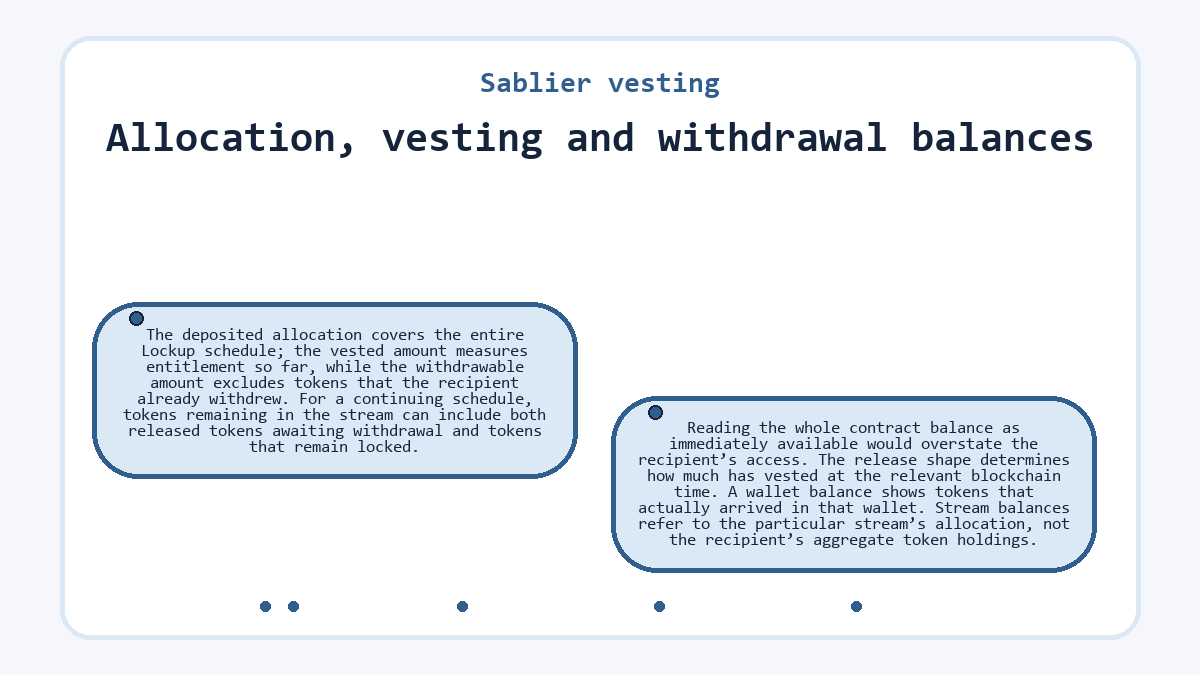
For a continuing schedule, tokens remaining in the stream can include both released tokens awaiting withdrawal and tokens that remain locked. Reading the whole contract balance as immediately available would overstate the recipient’s access. The release shape determines how much has vested at the relevant blockchain time. A wallet balance shows tokens that actually arrived in that wallet. Stream balances refer to the particular stream’s allocation, not the recipient’s aggregate token holdings.
Release shapes and cliff behavior
The basic Linear shape releases tokens at a constant rate between its configured times. An initial unlock can make part of the allocation available immediately, with the remaining amount following the continuing schedule.
A cliff delays a release until its specified time. The Unlock Cliff shape combines an initial release with a cliff on the remaining allocation, followed by linear vesting. Zero availability before a cliff therefore applies to a schedule without an initial unlock; it isn’t a universal rule for every cliff-based shape.
Dynamic streams use segments with their own token amounts, exponents and end times. These parameters support changing release rates, including backloaded curves. Equal fractions of elapsed time needn’t unlock equal fractions of the allocation.
Tranched schedules release specified amounts at discrete timestamps; a timelock can withhold the entire allocation until its release time. The amounts in a Tranched stream must sum to its funded deposit. Past tranche unlocks accumulate if the recipient leaves them unwithdrawn. A periodic release schedule therefore differs from a linear stream even when both share an end date.
Creation limits after the maintenance change
Sablier Labs stopped active product development in July 2026 and committed to maintaining its interface and backend through June 2028. The hosted EVM interface’s July 13, 2026 creation restriction excludes new vesting streams ending later than June 2028.
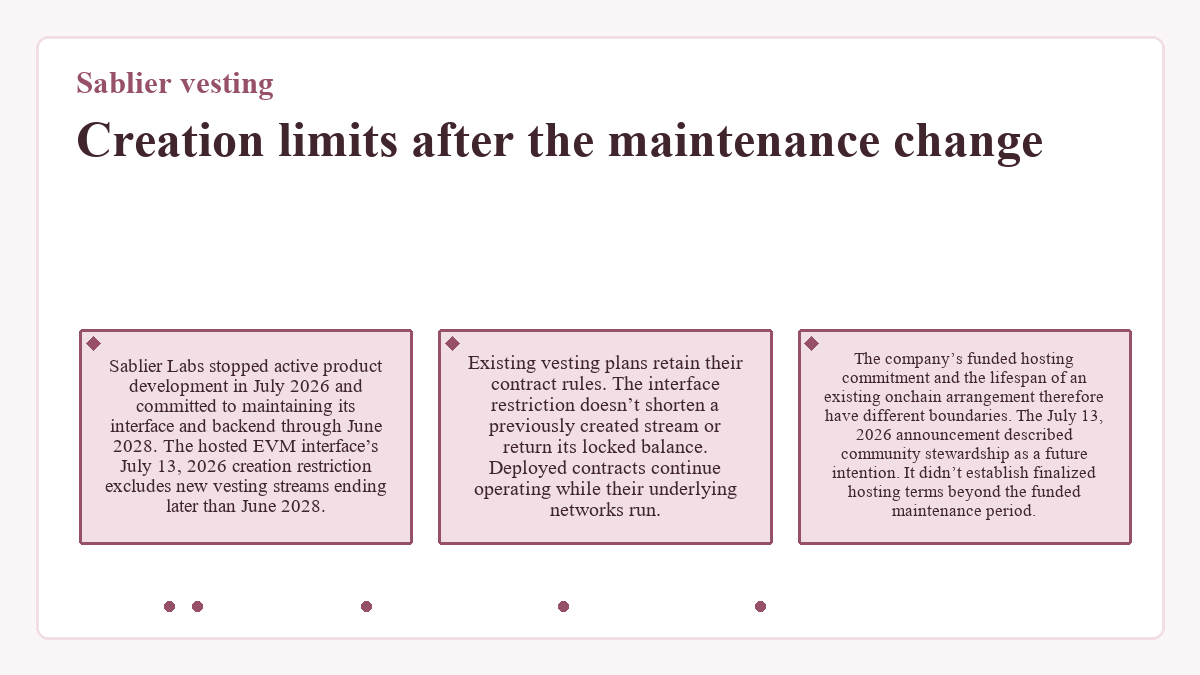
Existing vesting plans retain their contract rules. The interface restriction doesn’t shorten a previously created stream or return its locked balance. Deployed contracts continue operating while their underlying networks run. The company’s funded hosting commitment and the lifespan of an existing onchain arrangement therefore have different boundaries.
The July 13, 2026 announcement described community stewardship as a future intention. It didn’t establish finalized hosting terms beyond the funded maintenance period.
Does an airdrop claim start the vesting clock?
A ranged vested airdrop starts every recipient’s vesting at the campaign’s chosen common time. A non-ranged campaign starts each recipient’s vesting when they claim.
In a Lockup-based vested campaign, a successful claim creates the recipient’s stream. A ranged claim can create a stream whose vesting has already started. The release schedule determines the amount available for withdrawal. A claim can establish a position with tokens still locked; it doesn’t necessarily deliver the full allocation into the wallet.
Variable Claim Airdrops apply a different early-claim rule. A recipient who claims early takes the vested portion and forfeits the unvested remainder back to the campaign. The campaign administrator can recover those forfeited tokens after the campaign expires. That forfeiture belongs to this campaign type and shouldn’t be applied to an ordinary vested-stream withdrawal.
Recipient ownership and transfer restrictions
An EVM Lockup stream uses an ERC-721 NFT to identify its recipient. The NFT holder has the stream’s recipient rights, including entitlement to future releases under the existing schedule.
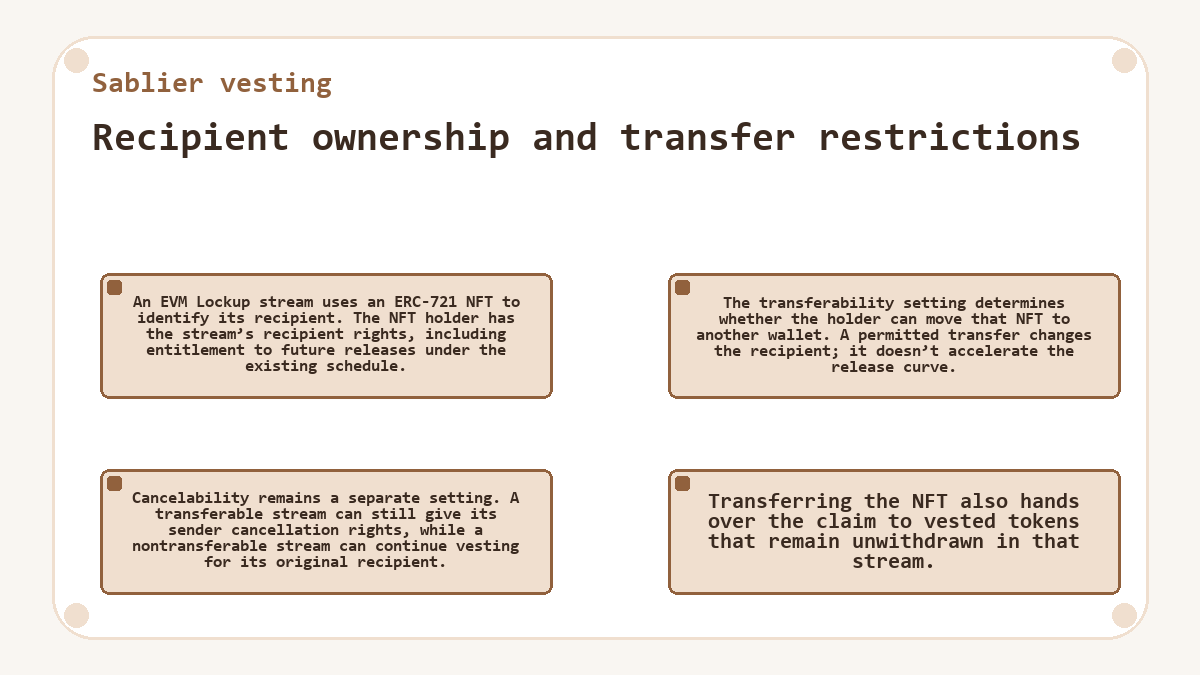
The transferability setting determines whether the holder can move that NFT to another wallet. A permitted transfer changes the recipient; it doesn’t accelerate the release curve. Cancelability remains a separate setting. A transferable stream can still give its sender cancellation rights, while a nontransferable stream can continue vesting for its original recipient. Transferring the NFT also hands over the claim to vested tokens that remain unwithdrawn in that stream.
Withdrawal timing and transaction costs
Each withdrawal through the interface carries its own applicable charge, so withdrawal frequency affects costs without changing the release schedule. The listed withdrawal fee is $0.99 for Lockup v2.0 and later, before any sender subsidy. Earlier Lockup releases don’t incur that interface withdrawal fee. The fee uses USD pricing, but payment uses the network’s native gas token.
Gas covers blockchain transactions; the passage of time doesn’t generate a continuous gas bill. A configured sender subsidy can partially or fully cover the interface fee. That subsidy mechanism doesn’t cover network gas. Withdrawing accumulated tokens less often reduces the number of charged withdrawals, without changing the quantity that the schedule vests.
Conditions for completing a vested withdrawal
A
SETTLED
EVM Lockup stream has completed its schedule but still holds tokens for its recipient. Missing native gas funds can prevent a recipient from submitting a withdrawal even after vesting finishes.
- Match the stream’s network, contract and identifier before using its displayed balance.
- Confirm the current recipient through the stream NFT, especially after a permitted NFT transfer.
- Use the remaining withdrawable amount, excluding tokens that earlier withdrawals already paid out.
- Allow for network gas and any interface fee that the sender hasn’t subsidized.
- After the withdrawal succeeds, compare the amount transferred with the decrease in the settled stream’s withdrawable balance.
A partial withdrawal leaves the remaining vested tokens in the stream. The
DEPLETED
state means withdrawals and any applicable refunds have exhausted its allocation. That status alone doesn’t identify how much went to the recipient, because sender refunds can also contribute to depletion.
Solana plans and the claiming-only app
The Solana claiming app supports withdrawals from existing streams represented by verified Solana mainnet Lockup NFTs. It doesn’t create or cancel streams. The planned June 30, 2026 interface takedown gave way to this limited app; it didn’t remove Sablier’s deployed Solana programs.
Senders seeking cancellation must interact with those programs directly. Success still depends on the plan’s cancellation terms. The narrower hosted app doesn’t grant a cancellation right to an otherwise uncancelable stream. Solana’s claiming-only access and the EVM interface’s creation horizon concern different hosted services.
Schedule completion and limits on changing terms
Time-based Lockup vesting fixes a funded token-release schedule. Flow tracks payment debt, while Bob vaults apply price or expiry conditions to deposited tokens.
Lockup’s non-upgradeable distribution logic prevents an administrator from rewriting a user’s stream. Sender cancellation, when available, comes from a permission that the plan already contains. The protocol also has administrative functions, including fee configuration and NFT display settings. Immutability doesn’t mean that every operational parameter is fixed.
A vesting plan governs token quantities and timing. It doesn’t set the token’s future market price or establish the cash value of an eventual withdrawal.
Frequently asked questions about Sablier vesting
Can a sender permanently give up a vesting stream’s cancellation right?
A sender can permanently renounce cancellation rights on a cancelable Lockup stream while it’s pending or streaming. That change makes the stream uncancelable. The sender can’t reverse it later. Renunciation doesn’t withdraw funds or accelerate the schedule. The existing recipient continues to vest under the stream’s release rules.
Are unclaimed vested airdrop allocations already funded Lockup streams?
An unclaimed allocation in a Lockup-based Merkle campaign doesn’t yet have its own funded stream. A successful claim creates the stream. Campaign creation also doesn’t require immediate token funding. Eligibility, campaign funding and stream creation establish different things, so a listed allocation alone doesn’t show that a funded vesting position already exists.
Is an airdrop claim deadline identical to its vesting end date?
A campaign’s claim deadline controls how long eligible addresses can claim, while its vesting end date controls token release. Campaigns can have an expiry or no expiry. For an expiring campaign, missing the claim window can prevent creation of the recipient’s vesting stream even though its release schedule covers a different period.
How can a creator stop unclaimed ranged allocations before campaign expiry?
Stopping an unclaimed ranged allocation can require a claim on the recipient’s behalf followed by cancellation of the resulting Lockup stream. The resulting stream must be cancelable and still pending or streaming when its designated sender cancels it. It’s separate from recovering unclaimed tokens directly from the campaign, which follows the campaign’s own recovery rules.
Does an untransferable vesting NFT restrict tokens after withdrawal?
The untransferable setting restricts the stream NFT and doesn’t add a second vesting period to tokens already withdrawn. It also doesn’t block the recipient from withdrawing vested tokens under the stream’s rules. Any separate transfer restrictions in the underlying token contract still apply.
Will an existing vesting stream always appear in the hosted interface?
An onchain vesting stream can exist on a network that the hosted interface doesn’t support. Access to such a stream may require programmatic interaction with its applicable contract release. Missing interface visibility doesn’t establish that a stream has ended, lost its funding or become cancelable.
Could someone else redirect a vesting withdrawal without owning the stream NFT?
For the current EVM Lockup withdrawal function, an approved NFT operator can choose another payout address; an unrelated caller can withdraw only to the recipient. The recipient can also select another nonzero destination. The requested amount must be positive and within the withdrawable balance; the caller must also satisfy fee requirements. Public call access doesn’t give a stranger permission to redirect the tokens.